
Happy New Year!
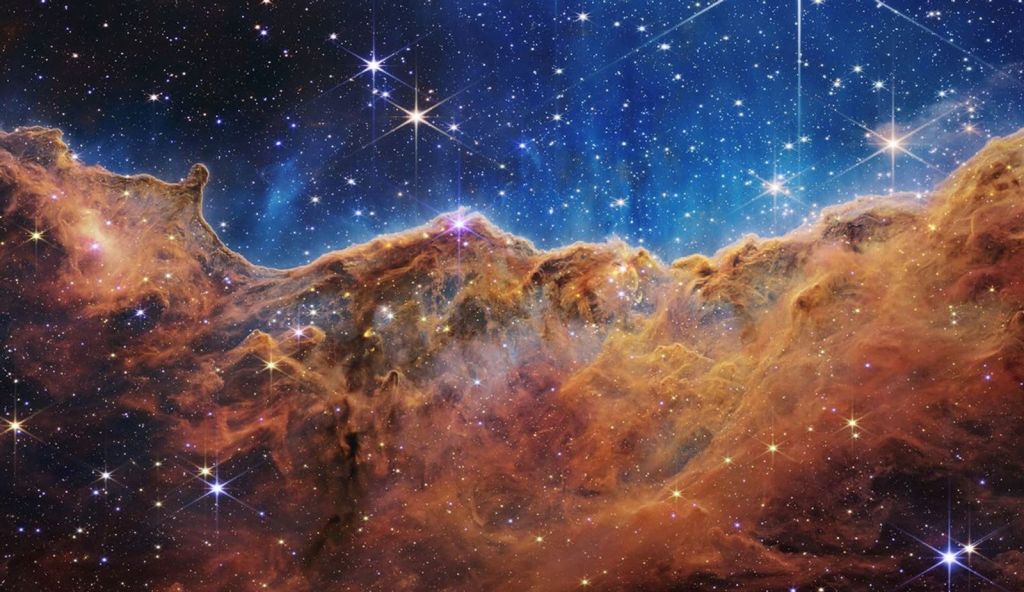
To kick off 2026, I’d like to talk about something light and breezy… like the size of the universe.
📌 In This Edition…
- Cosmic Reflection: We’re tiny…
- Writing Update: Manuscript in progress!
🚀 The Heavens
The first book I read in 2026 was Atmosphere by Taylor Jenkins Reid—a historical fiction novel set in the mid-1980s, following women on the front lines of space exploration.
I’ve been thinking more and more about space lately (call it “spiritual maturity”… or a non-invasive mid-life crisis). Either way, the more I learn, the more I am convinced that the universe was designed to do one thing really well—that is to humble us.
In November, I watched a video where a couple of guys recreated our solar system to scale (go check it out—it’s honestly something to behold). In the video, they showed that if the Earth were the size of a marble, you’d need seven miles of open space to accurately represent our solar system.
Let me put on my elementary science teacher hat for a quick cosmic refresher: our solar system—“the BIG YELLOW ONE is the SUN!”, eight planets (or nine, if you’re loyal to Pluto), plus a buncha comets and asteroids ‘n stuff—is only a tiny speck inside the Milky Way Galaxy. The Milky Way alone contains more than 100 billion stars (our Big Yellow One included). Astronomers estimate that there are over 2 trillion galaxies in the “observable universe.”
Meaning the universe may contain up to one septillion stars.
That is a number so preposterously large that my brain sounds like dial-up internet trying to even think about it. A one with 24 zeros:
1,000,000,000,000,000,000,000,000 stars.
If you counted once per second, it would take 31.7 trillion years to reach a septillion.
Here’s some more craziness: the brightest star in the night sky is Sirius, and it’s 8.6 light-years away.
A light-year is simply the distance light travels in one year. And since light moves at 186,000 miles per second, that means one light-year is roughly 5.88 trillion miles.
So when you look up at Sirius, you’re not seeing it in real time. You’re seeing light that left Sirius about 8.6 years ago… and is only now arriving in your eyeballs.
And that’s one of the closer stars. Light from other stars can take hundreds—even thousands—of years to reach us.
Take Stephenson 2-18, for example. This massive red supergiant is about 19,000 light-years away, and it’s considered one of the largest known stars in the observable universe. If Stephenson 2-18 sat at the center of our solar system, its surface would stretch beyond the orbit of Saturn—engulfing Mercury, Venus, Earth, Mars, and Jupiter along the way. (Check this out for more eye-popping stats about Stephenson 2-18).
For perspective: in 1997, NASA launched the Cassini spacecraft to study Saturn and its system. It took nearly seven years for Cassini to reach Saturn.
The size of Stephenson 2-18 is… is… astronomical (lol, get it?). The youths would call it chonky.
(Like I said, I may indeed be deep into a non-invasive mid-life crisis here…)
“The heavens declare the glory of God; and the firmament [the expanse of heaven] proclaims the work of his hands.”
Stephenson 2-18 is the kind of scale that makes you feel small—in the best possible way. It helps give me perspective. It reminds me that the universe doesn’t exist to make much of me. It exists to make much of Someone else.
That’s why Psalm 19 has been echoing in my head lately: “The heavens declare the glory of God.” The sky isn’t just scenery. It’s a sermon. And night after night—without saying a word—it keeps preaching.
It’s something King David understood perfectly when he wrote those words.
David wasn’t writing Psalms over a half-caff oat milk honey lavender latte with cinnamon foam. He was a king in the ancient world—an era of tribal warfare, unstable alliances, and very real political chaos (though I like to imagine he had a “Hang In There” cat poster on papyrus somewhere in his chambers).
Israel was a small, vulnerable nation surrounded by enemies. “Having a bad week” could literally mean: Are we about to get invaded? Are we going to starve? Is my own son about to start a rebellion?
So when David looked up at the night sky and wrote, “The heavens declare the glory of God,” it wasn’t just poetic fluff. It was a man surrounded by real problems lifting his eyes anyway—and remembering who’s actually in charge. (Also: just imagine the psalms he could have written if he had access to the Hubble Space Telescope back then!)
My problems this month haven’t involved draught and invasions… but they’ve been real and hard all the same. We put down our 11-year-old faithful, family dog after a battle with lung cancer. A caregiving family we love lost their seven-year-old daughter with Trisomy 18 after months in the ICU. A friend in our house church began chemo for stage IV cancer. Our home has held many tears lately.
Grief has a way of shrinking your world down. It suffocates. It hurts. It’s the stuff that made the ancients tear their robes and sit in ashes.
And yet—Psalm 19 says the heavens keep declaring the glory of God anyway. Night after night. Not as a distraction from pain. Not as a way of pretending everything is fine. But as a reminder that even when life feels unbearably small and heavy… God is still vast and present.
So that’s where I am right now—looking up more than usual. Not because it makes the grief disappear, but because it reminds me my grief isn’t the biggest thing out there. The heavens don’t deny our sorrow, but they can help us find perspective.
And Scripture doesn’t gloss over grief either. It doesn’t rush us past it. It actually blesses the mourner. “Blessed are those who mourn, for they will be comforted” (Matthew 5:4). And it offers one of the most tender promises in the Bible, again, from David: “The Lord is close to the brokenhearted” (Psalm 34:18).
And if your heart feels broken in this season, take courage: you are not forgotten. You are not alone. Lift up your eyes. He is near.
✒ Writing Update
My outline has been approved, and I’ve started working on my manuscript!
I’ll share sections with you over the coming months.
That’s all you get for now!
With gratitude,
David
P.S.
In case you missed it, I was published last month as the cover story in CMDA Today!
👉 CLICK HERE to read or share the digital issue!

 DAVID SCOT MUSSER